

XRF Detection of Protein Powder Contamination
The Growing Challenge of Heavy Metal Contamination
In this article, we’ll explore how the Z-Spec E-Max 500 can play a critical role in detecting heavy metal contamination in protein powders and ensuring consumer safety.
To provide context, a recent report by the Clean Label Project revealed alarming findings for protein powder consumers. Specifically, the study analysed 160 protein powder products from 70 leading brands, representing an impressive 83% of the US market. The findings are concerning: 47% of tested products exceeded US state and federal safety limits e.g. California’s Proposal 65 standards for heavy metals.
While whey-protein powders exceeded limits 26-28% of the time, chocolate protein powders were significantly worse, with 65% exceeding the limits. Alarmingly, plant-based and organic powders showed far more contamination than whey-based alternatives, with 2x more Lead and 3x more Cadmium. Even worse, 41% of organic powders and 29% of chocolate powders were found to have 2x the limit for Lead. These findings, reported by the Clean Label Project, highlight the need for improved consumer awareness.

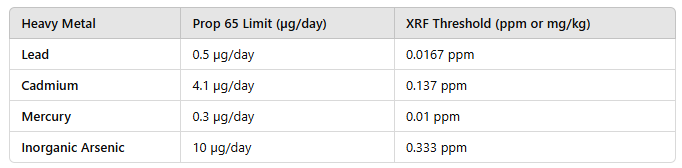
This survey was done on the US market. In the UK there are no explicit limits on protein powders. Heavy metal safety limits on food are covered by the EU’s 1881/2006 but this does not contain limits for protein powders. The US’s California Proposal 65’s limits are low (especially Lead), but both Arsenic and Cadmium could be rapidly analysed by the latest XRF technology which is much faster than traditional ICP / ICP-MS.
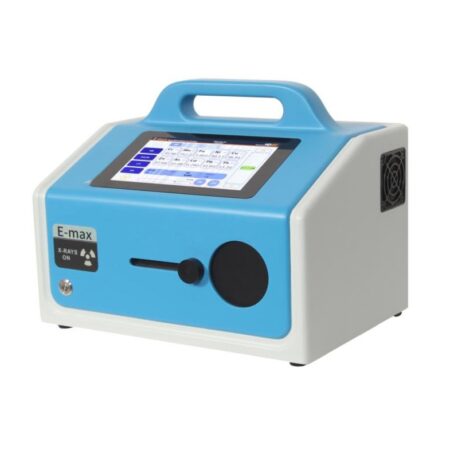
Introducing the Z-Spec E-max
Revolutionising Heavy Metal Detection
The Z-Spec E-max is powered by Monochromatic Energy-Dispersive X-Ray Fluorescence (HD XRF® / MXRF) technology. An elemental analysis technique offering significantly enhanced detection performance over traditional Energy Dispersive X-ray Fluorescence (ED XRF) technology. It features:
-
Excellent Limits of Detection (LOD): The E-max has an LOD of 0.06 mg/kg for Cadmium surpassing traditional XRF methods.
-
High Precision and Accuracy: Testing with certified reference materials (e.g., ERM BD513, BD514) showed Relative Standard Deviations (RSD) of less than 7%, confirming reliable reproducibility.
-
Rapid Analysis: Each measurement takes just 200 seconds, and the instrument can analyse up 40 elements simultaneously!
The other Z-Spec products in the range cover other elements on this list e.g. the Z-Spec Z-Max which has an LoD of 0.015 mg/kg of Arsenic, 0.02 mg/kg for Mercury and 0.1 mg/kg for Chromium. Or the JP500, which covers a similar range to the Z-max but with an improved limit of 0.015 mg/kg of Mercury.
Other Real-World Applications
Z-Spec products have plenty of other applications; a Application Note that highlights the E-Max’s capability to analyse Cd in chocolate production. In this study, cocoa beans, powder, and liquor samples were tested with minimal preparation. Results were consistent with ICP-MS. What’s more, the ability to run raw or processed samples, with minimal sample prep, means it’s easy to run more samples.
Validation Against ICP-MS
A recent Helyion paper meanwhile, compared the E-max to Inductively Coupled Plasma Mass Spectrometry (ICP-MS) demonstrated strong correlations for various matrices, including cacao beans (R² = 0.99) and soil (R² = 0.99). For instance, a calibration curve for cocoa powder revealed an almost 1:1 correlation with ICP-MS.
Compared to ICP-MS though, E-max’s small form factor, easy sample preparation and fast analysis times make it a much simpler solution for use in routine laboratories.

Conclusion
The Z-Spec E-max sets a new benchmark for rapid heavy metal screening and detection in food safety. By combining rapid analysis, excellent sensitivity, and ease of use, it offers an easy to use and cost-effective alternative to traditional methods like ICP-MS. Its adaptability extends beyond food safety, with potential applications in environmental testing and beyond.
For more information on integrating the E-max into your workflow, visit the product page.
